Mar 09, 2026
The 2026 VA Fraud Hunt: How to Make Your Claim Bulletproof (And Avoid the ‘Claim Sharks’)

![[HERO] The 2026 VA Fraud Hunt: How to Make Your Claim Bulletproof (And Avoid the ‘Claim Sharks’)](https://cdn.marblism.com/KkDINHaKLmi.webp)
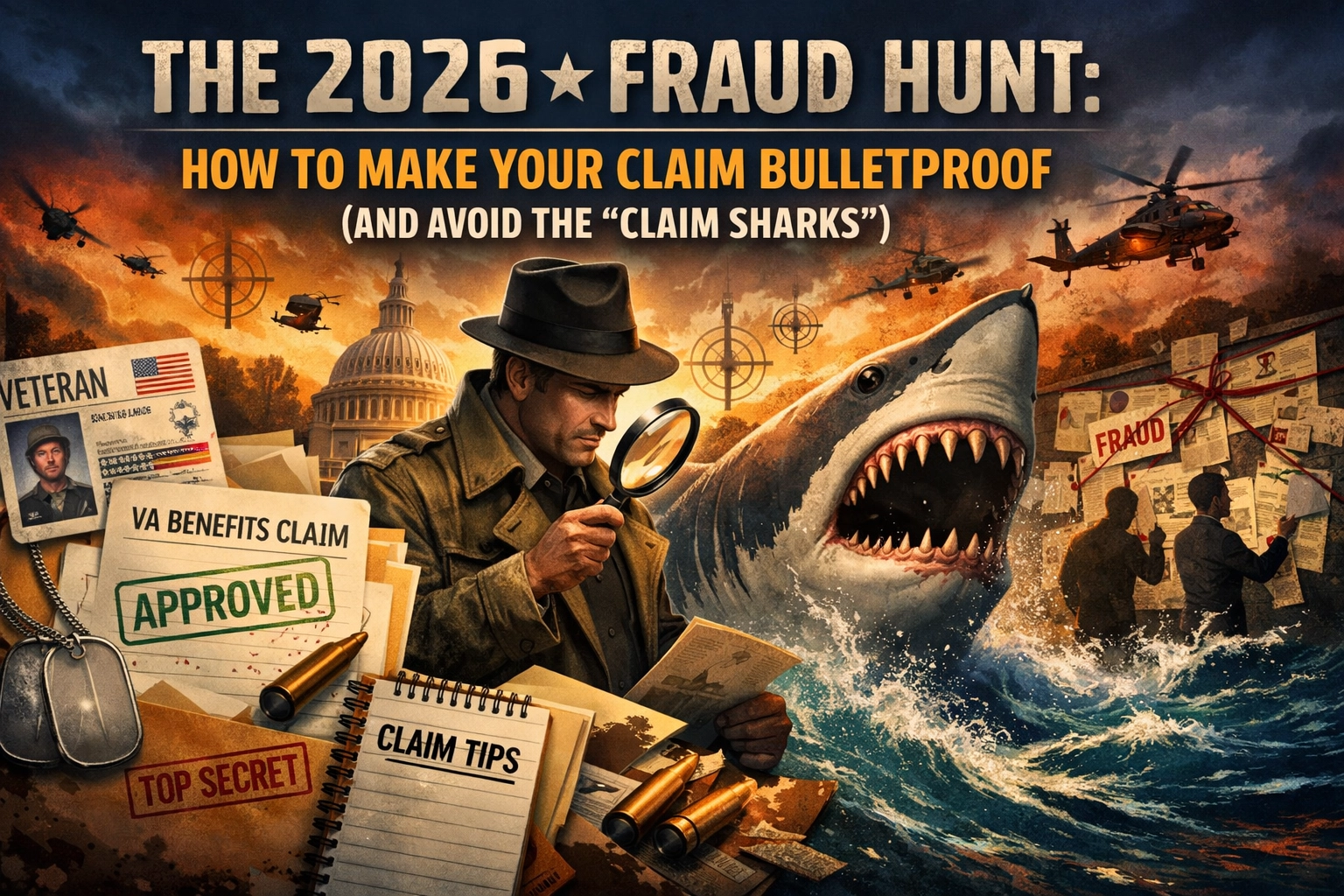
The landscape of the VA disability claims process shifted significantly in early 2026. President Trump and Vice President JD Vance have officially launched a high-level "War on Fraud" task force. This isn't just political talk; it is a full-scale operational shift within the Department of Veterans Affairs. For the average veteran, this news might sound intimidating. You might be wondering if your current rating is under fire or if your new application will be caught in a net designed to catch criminals.
Here is the bottom line: The hunt is on, but it isn’t targeting honest veterans. It is targeting the "Claim Sharks" and organized fraud rings that have been exploiting the system for years. However, to stay out of the crosshairs, you need to change how you approach your claim. You can no longer rely on "cookie-cutter" documentation or questionable third-party services. You must become your own best advocate through education.
Vice President JD Vance is leading a multi-agency task force designed to scrub the VA disability system for inconsistencies. The primary focus of this initiative is the use of "predatory" third-party companies. These companies, often called "Claim Sharks," are for-profit entities that are not accredited by the VA. They often charge thousands of dollars: sometimes a percentage of your backpay: to "help" you file.
The task force is specifically looking for:

Starting in fiscal year 2026, the VA rolled out a sophisticated data analytics tool. Think of it as a digital investigator that never sleeps. It scans every document uploaded to your file: especially DBQs and Nexus Letters: looking for "telltale signs" of fraud.
This tool is designed to flag specific red flags that previously might have slipped past a human rater. If your claim gets flagged, it doesn't necessarily mean a denial, but it does mean a massive delay and a much higher level of scrutiny. To keep your claim moving, you need to avoid the patterns this AI is trained to catch.
One of the biggest triggers for the new AI tool is the location of your medical examiner. If you live in Florida, but your DBQ was signed by a doctor in California whom you’ve never met in person, the system will flag it immediately. The VA is now looking for:
To protect your benefits, you must be able to identify predatory companies. These "sharks" often mask themselves as veteran-owned or "advocacy" groups, but their business model relies on high-volume, low-quality documentation that the VA is now actively hunting.
Signs you are dealing with a Claim Shark:

In this high-scrutiny environment, the only way to win is to be "bulletproof." This means your evidence must be clinical, honest, and uniquely yours. Use this VA disability claim checklist to ensure your paperwork doesn't trigger the fraud detectors:

If you’ve been denied recently, you might be considering a supplemental claim VA. This is a powerful tool, but in 2026, it requires "New and Relevant" evidence. Simply resubmitting the same paperwork that was flagged or ignored the first time will lead to a swift denial.
When filing a supplemental claim under the new task force's watch, focus on correcting the "Nexus." If your previous claim was flagged because the doctor was too far away or the language was too generic, your supplemental claim must provide a more localized, detailed medical opinion. Use the supplemental process to bridge the gap between your service and your current health status with objective data: like MRI results, private treatment records, and pharmacy logs.
At Victus Elite Consilium Group, we’ve watched the VA’s tactics change over the years. We saw the "Denial Machine" coming, and we saw the "Fraud Hunt" coming. Our philosophy has always been simple: Knowledge is your best defense.
We are an E-Learning company. We don't file your claim for you. We don't write your DBQs. We don't charge you a percentage of your benefits. Instead, we teach you how the system works. When you understand the "why" behind the VA's requirements, you can't be fooled by claim sharks, and you won't be flagged by AI.
By handling your own claim through the knowledge you gain, you prove to the VA that you are an informed, honest veteran simply seeking the benefits you earned. There is no "middleman" for the VA to flag. It’s just you, your medical evidence, and the law.

If you have a claim currently in the system, or you are getting ready to file, follow these imperative steps:

The "Fraud Hunt" of 2026 is a response to years of bad actors taking advantage of veterans and the VA. While the increased scrutiny can feel like a burden, it actually levels the playing field for veterans who are doing things the right way.
If your claim is based on honest medical evidence, clear service connection, and your own voice, you have nothing to fear from a task force or an AI tool. The goal is to move away from the "quick fix" services and move toward a model of self-advocacy and education.
You earned these benefits through your service and sacrifice. Don't let a "Claim Shark" take a cut of your future, and don't let a "DBQ Mill" get your claim flagged for fraud. Take the lead, get educated, and make your claim bulletproof.
Need to get your evidence in order? Check out our other guides on mastering the VA disability claims process and making sure your supplemental claim VA is ready for the high-scrutiny environment of 2026.